Most companies default to whichever model their last vendor happened to offer, without ever comparing it against the alternatives. There are genuinely three distinct ways an office interior project gets delivered in India, and Officea Design & Build undertakes all three — design and build, turnkey, and general contracting — because the right one depends entirely on your situation, not on which model a given company happens to sell. This article lays out what each actually means and where each genuinely fits, so you can decide rather than default.
General contracting: you bring the design, we build it
General contracting is the most traditional model. You, or your own architect or interior designer, produce the drawings, material specifications and finish schedule. The general contractor's job is purely execution — civil work, MEP, procurement of the specified materials, site labour management, and delivering exactly what was drawn, on the agreed timeline and budget.
This model fits companies that already have a design relationship they're committed to — a global headquarters design standard that has to be replicated locally, an architect the company has worked with for years, or an in-house design team producing the drawings. What you're buying is reliable, accountable execution, not design input. The contractor isn't responsible for whether the design itself works well; they're responsible for building it correctly, on time, to specification.
The trade-off is coordination: if the drawings have a gap, an unbuildable detail, or a missing spec, that gap is now the client's problem to resolve with the original designer, not the contractor's to absorb. A general contracting relationship works best when the design package handed over is genuinely complete and buildable.
Design and build: one contract, one team, from layout to handover
Design and build puts design and construction under a single contract with a single accountable team. The same company that draws the layout is responsible for building it, which removes the coordination gap that general contracting can leave open. Design decisions get made with construction cost and buildability in view from day one, not discovered as a problem partway through fit-out.
This fits companies that don't already have a design relationship in place, or that specifically want single-point accountability for both the design outcome and the execution outcome. If a completion date slips or a cost overruns, there's one team to ask, not two pointing at each other. It also tends to move faster than a split design-then-build sequence, since there's no formal handoff between two separate vendors.
A recent Officea project illustrates this directly: a 3,000 sq ft Gurgaon office, quoted at 60 days under a design and build contract, delivered in 28 — a result of the same team owning both the drawing and the site schedule, with no vendor-to-vendor handoff delay in between.
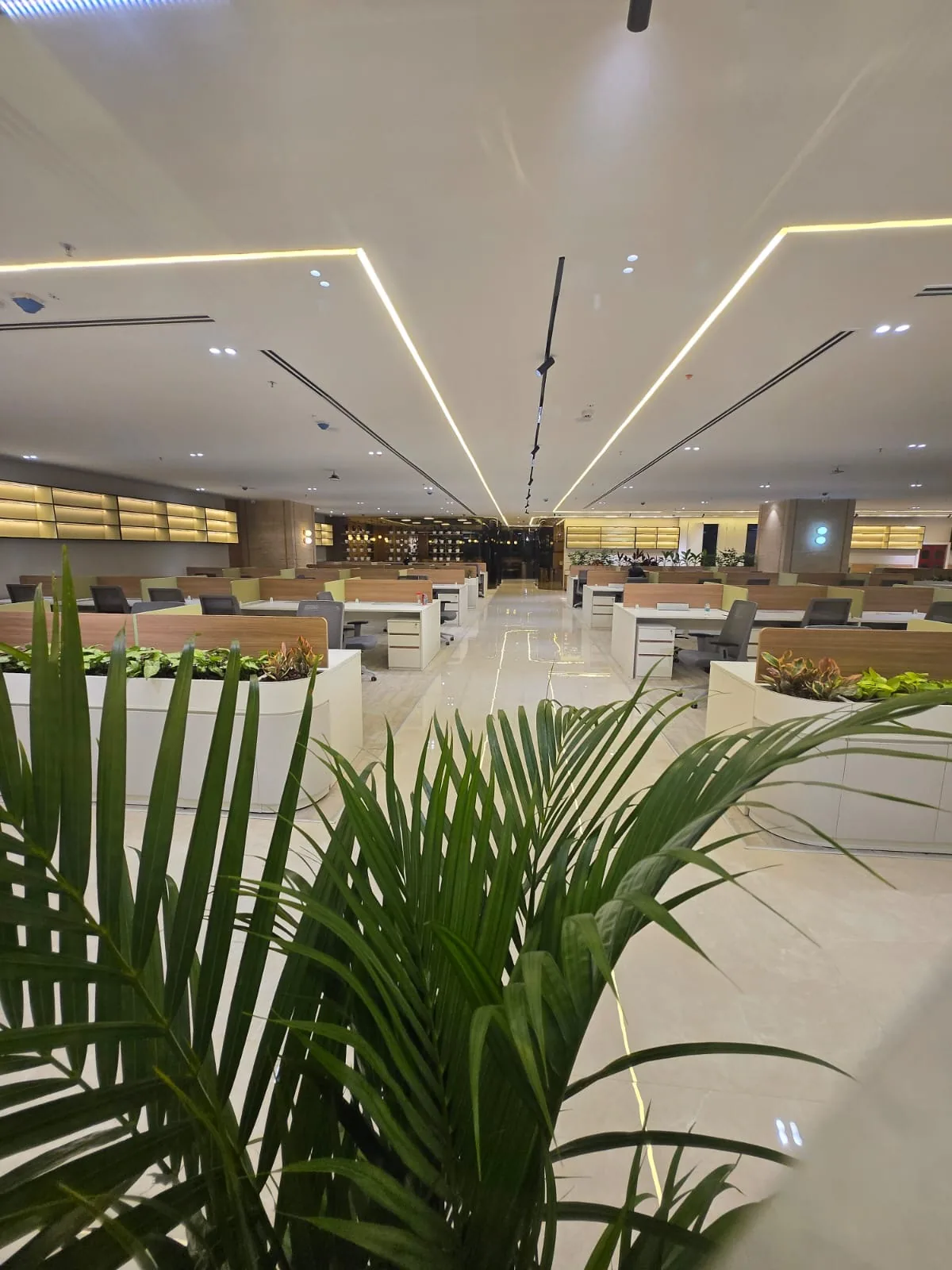
Turnkey: hand over a brief, receive a finished, move-in-ready office
Turnkey is the most complete of the three models. Beyond design and construction, a turnkey scope typically extends to furniture procurement and installation, IT and AV infrastructure, signage, and often the final housekeeping and setup needed to walk in and start working on day one. The client's involvement can be as light as approving a brief and a few key decisions along the way — everything else, including vendor coordination across every trade and category, sits with the turnkey partner.
This fits companies opening a satellite or branch office without a local facilities team to manage vendors, companies that simply want the entire process off their plate, or any project where minimising internal involvement matters more than being hands-on with every material choice. A 10,000 sq ft Noida office with full MEP scope and a high-end specification, delivered by Officea in 43 days against a 75-day quote, ran under this kind of single-scope model — design, full MEP, and finish-to-handover all inside one commitment.
What to check regardless of which model you choose
- Is the quotation itemised by trade, or one lump number? This matters equally under all three models — a single figure hides where the money is going.
- Who is accountable if a completion date slips? Under general contracting, check whether design-gap delays are contractually the client's risk or the contractor's. Under design and build or turnkey, this should be unambiguous.
- What does the warranty period actually cover, and for how long? Ask for the defects liability period in writing under any of the three models.
- How are change requests priced and approved? A vague answer here usually means changes get priced informally, after the fact.
- Can they show a project that didn't go entirely to plan? Every real company has one, under every delivery model. How they talk about it tells you more than a polished case study.
Planning a project like this? Officea Design & Build will prepare a costed proposal for your office, free of charge.
Honest about where none of these models removes all risk
Complex material work — custom stone cladding, curved glass, imported finishes — genuinely takes the time it takes, under any of the three models, and internal client approval cycles can extend a timeline regardless of how well the vendor coordinates. A recent Officea project in Bangalore, 28,000 sq ft with extensive stone cladding and curved glass throughout, ran 15 days beyond its 90-day quote — not because of a design or construction failure, but because of approval sign-offs on the client's end. We'd rather publish that project honestly than only show the ones that beat their timeline, because a company that only shows wins isn't giving you a real picture of how these projects actually run, under whichever model you pick.
Letting the project decide, not the vendor
None of these three models is universally better — each solves a different problem. Already have an architect and just need reliable execution? General contracting. Want single accountability for both design and build, with no existing design relationship to work around? Design and build. Want to hand off the entire process, including furniture and setup, and walk into a finished office? Turnkey. Officea Design & Build runs projects under all three, and the right starting conversation is usually about your situation, not about which model happens to be on offer.