Office interior cost per square foot is the first number every company asks for and the hardest one to get a straight answer to, because the honest answer is "it depends on the tier, the city, and the building." What follows is a genuine breakdown of what basic, mid-range, premium and luxury office interiors cost in 2026 across six of India's largest commercial hubs — Delhi, Gurgaon, Noida, Bangalore, Pune and Hyderabad — along with the construction timeline each tier typically needs and the keywords worth knowing if you're researching this yourself.
Basic tier — ₹1,800–2,000 per sq ft
A Basic fit-out covers the functional essentials: laminate-finish workstations, vinyl or entry-level carpet tile flooring, a painted gypsum ceiling, standard fluorescent or basic LED lighting, and simple partition walls where needed. There's no design flourish here — the goal is a clean, working office at the lowest reasonable cost. This tier suits early-stage startups, back-office and support teams, and any company prioritising headcount over impression. Officea Design & Build delivers Basic-tier fit-outs across all six cities covered here under a single design and build contract.
Construction phase timeline for Basic: design finalisation 1–2 weeks, civil and partition work 3–4 weeks, electrical and lighting installation running in parallel at 2–3 weeks, flooring and ceiling 2 weeks, furniture installation 1 week, snagging and handover 1 week. A 5,000 sq ft Basic-tier office typically closes in 8–10 weeks end to end.
Medium tier — ₹2,200–2,400 per sq ft
Medium is the corporate-standard tier most established companies land on. Materials step up across the board: better laminates with a wider colour and texture range, branded carpet tile instead of a generic one, a mix of gypsum and modular ceiling for a more finished look, and proper task lighting at desks alongside ambient lighting in shared areas. Cabins typically get glazed fronts rather than solid walls, and meeting rooms get basic AV provisioning.
Construction phase timeline for Medium: design development runs 2–3 weeks given the added material decisions, civil and partitions 4–5 weeks, MEP (electrical, HVAC touch-points, fire safety) 3–4 weeks in parallel, flooring and ceiling 2–3 weeks, furniture and finishing 1–2 weeks, snagging 1–2 weeks. A 10,000 sq ft Medium-tier office typically runs 12–16 weeks.
Good/Premium tier — ₹2,600–3,000 per sq ft
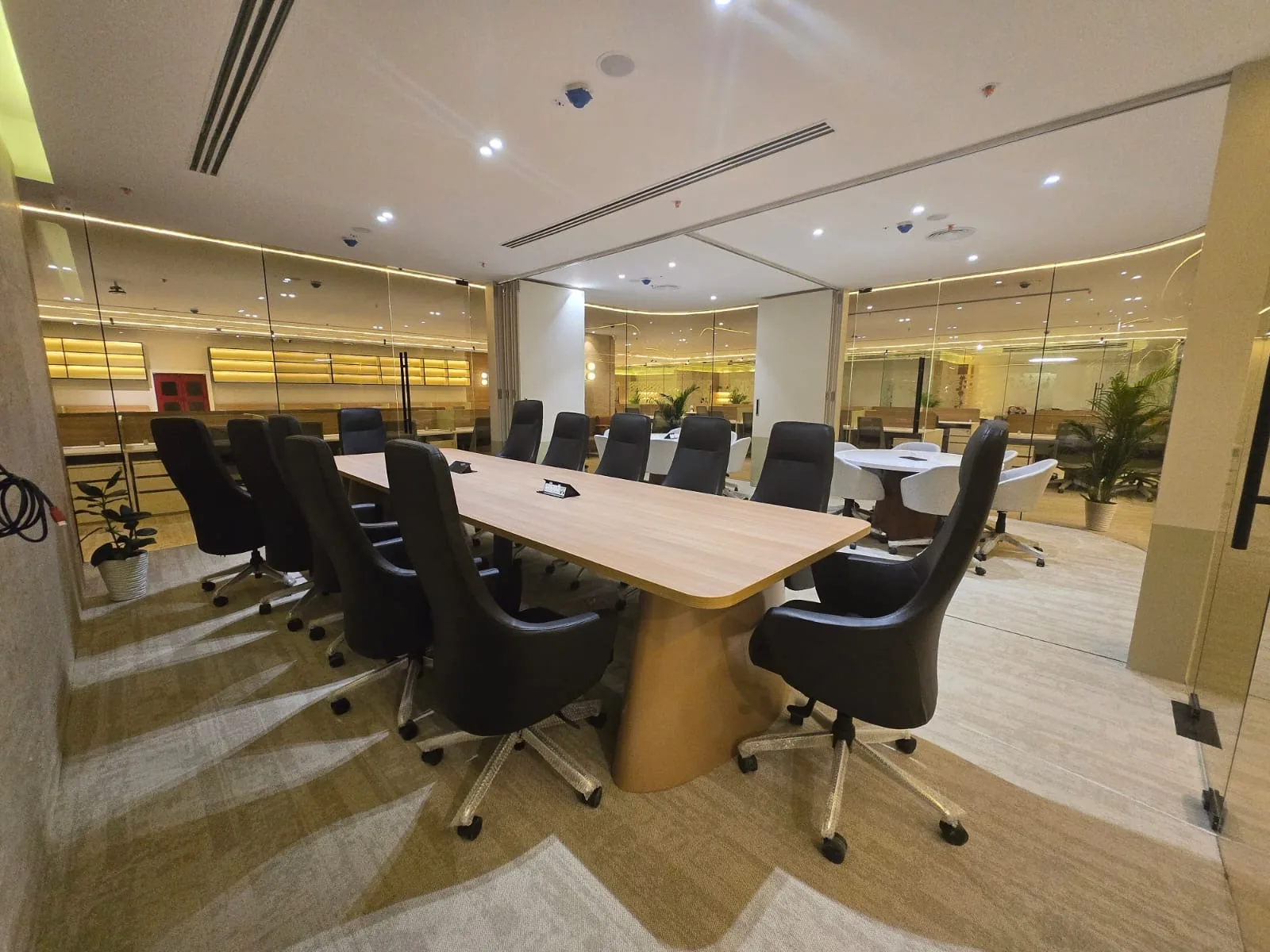
Good tier is where a genuine design identity starts to show: veneer or engineered-wood accents in reception and cabins, premium carpet tile or a mix of carpet and vinyl plank, fully glazed cabins and meeting rooms, better AV and video-conferencing setups, and more considered lighting design including feature and accent lighting. This tier is common for companies that treat the office as part of employer branding, and for client-facing businesses where the office is part of the pitch. This is the tier Officea Design & Build sees most often from established corporates and GCCs across Delhi, Gurgaon, Noida and Bangalore.
Construction phase timeline for Premium: design development 3–4 weeks (more material and vendor decisions), civil and partitions 5–6 weeks, MEP 4–5 weeks, flooring/ceiling/joinery 3–4 weeks (custom joinery adds real time here), furniture 2 weeks, snagging 2 weeks. A 15,000–20,000 sq ft Premium office generally takes 16–22 weeks.
High-end/Luxury tier — ₹4,000–4,500+ per sq ft
High-end covers flagship headquarters and statement offices: natural stone or marble in reception and key zones, imported finishes, bespoke joinery built to a specific design rather than off a catalogue, statement lighting fixtures, curved or fully glazed facades, and often stone cladding on feature walls. This is also the tier most likely to run over an initial timeline estimate, not because of poor planning but because bespoke fabrication — curved glass panels, custom stone cutting, imported material lead times — genuinely takes longer than catalogue materials, and internal client approval cycles for these higher-stakes decisions tend to stretch too.
Construction phase timeline for High-end: design development 4–6 weeks, civil and partitions 6–8 weeks, MEP 5–6 weeks, custom joinery and stone/glass work 6–10 weeks (often the longest single phase, and the one most exposed to import and fabrication lead times), furniture 2–3 weeks, snagging 2–3 weeks. A 20,000+ sq ft High-end office commonly runs 20–30+ weeks, and material-heavy projects with curved glass or extensive stone cladding can run longer still.
How the six cities compare
Delhi carries a genuine spread — older buildings around Connaught Place and Nehru Place often need more civil and electrical upgrade work folded into the cost than a newer building, while Jasola and Mohan Cooperative run closer to standard rates.
Gurgaon has the highest share of warm-shell Grade-A stock of any city on this list, particularly across DLF Cyber City and Golf Course Road, which means civil cost per sq ft often runs at the lower end of each tier's range here, with spend shifting toward finishes rather than base infrastructure.
Noida is generally the most cost-competitive of the NCR cities, reflecting both lower base rent and a large, competitive local vendor and labour base around the Sector 62/132/135 corridor.
Bangalore costs vary sharply by corridor — Outer Ring Road and Whitefield tech park space typically has strong base infrastructure already in place, which can offset premium rents with lower MEP upgrade costs, while older CBD stock near MG Road needs more assessment.
Pune generally runs at or slightly below Bangalore and Gurgaon rates for comparable tiers, with Hinjewadi and Kharadi's large IT-park stock keeping the local vendor and material supply chain competitive.
Hyderabad follows a similar pattern to Pune — HITEC City, Gachibowli and the Financial District have a dense, mature commercial ecosystem that keeps fit-out costs broadly comparable to Bangalore's ORR corridor, tier for tier. Officea Design & Build's published rate card reflects exactly this Delhi-Gurgaon-Noida-Bangalore range, with Pune and Hyderabad following the same general market pattern.
What these rates include, and what they typically don't
Every range above covers civil work, MEP (electrical, HVAC touch-points, fire safety, plumbing), flooring, ceiling and standard finishes. Furniture is almost always quoted separately across the industry and typically adds 20–30% to total project cost depending on how much of the fit-out is workstations versus soft seating and storage. GST is additional on every figure above. IT and AV equipment, as distinct from the low-voltage cabling infrastructure, is also typically outside these ranges. Statutory approval costs — fire NOC, structural certification where applicable — are sometimes bundled in and sometimes billed separately, so it's worth confirming explicitly rather than assuming either way.
Planning a project like this? Officea Design & Build will prepare a costed proposal for your office, free of charge.
Why quotations for the same brief can still look different
Two vendors pricing the same 10,000 sq ft brief at the same stated tier can still land 15–20% apart, and the gap is rarely dishonesty — it's usually scope definition. A quotation that itemises civil, MEP, flooring, ceiling, furniture and fees separately is directly comparable to another itemised quotation. A single lump-sum number isn't, because it hides which specific inclusions and exclusions are baked into it. Before comparing two numbers, check whether both include the same scope: is furniture in or out, is fire-NOC and statutory approval cost included, is the electrical scope limited to the fit-out or does it include panel upgrades at the building's main distribution board, and what's the actual defects liability period behind the number.
Keywords worth knowing if you're researching this yourself
If you're comparing quotations or researching further, the terms that actually matter are: cost per square foot (not total project cost, which hides the tier), warm shell versus bare shell (a warm-shell building with base ceiling, flooring and MEP already in place is meaningfully cheaper to fit out than a bare shell), BOQ or bill of quantities (ask for one broken out by trade, not a single lump figure), design and build versus traditional fit-out (a single-contract model tends to have fewer hidden cost gaps than separate design and construction vendors), defects liability period (the warranty window after handover, typically six to twelve months), and change order (the formal process for pricing anything requested outside the original signed scope).
How floor position and building age affect the number
Two identical-tier fit-outs in the same city can still land apart if the underlying floor differs. A higher floor in a modern tower often costs marginally more to fit out than a lower floor in the same building, purely on material and equipment logistics — getting stone slabs or bulky furniture up to floor 18 takes longer and costs more than floor 3. Older buildings, regardless of city, more often carry hidden costs in electrical panel upgrades, fire system compliance updates, or structural checks before a fit-out can even begin, none of which show up in a per-square-foot rate quoted for a newer, warm-shell floor. A fair comparison across quotations has to account for which of these a given building actually needs.
A rough worked example
A 10,000 sq ft office at the Medium tier, taking the midpoint of ₹2,300 per sq ft, comes to roughly ₹2.3 crore before GST and before furniture. Add furniture at a conservative 20% and the realistic all-in budget, before GST, lands closer to ₹2.75 crore. The same floor at Premium tier (₹2,800/sq ft midpoint) runs closer to ₹2.8 crore for the fit-out alone, ₹3.35 crore with furniture. Scaling down to a 5,000 sq ft Medium-tier office puts the fit-out alone around ₹1.15 crore, roughly ₹1.4 crore with furniture. These are genuinely indicative numbers, useful for early budgeting conversations — a real quotation needs an actual site assessment of your specific floor, since building condition and access constraints can move the number in either direction.