
Brookfield's Candor TechSpace parks are two of Gurugram's largest campus-style office developments. This guide answers the questions companies ask before leasing and fitting out space in them.
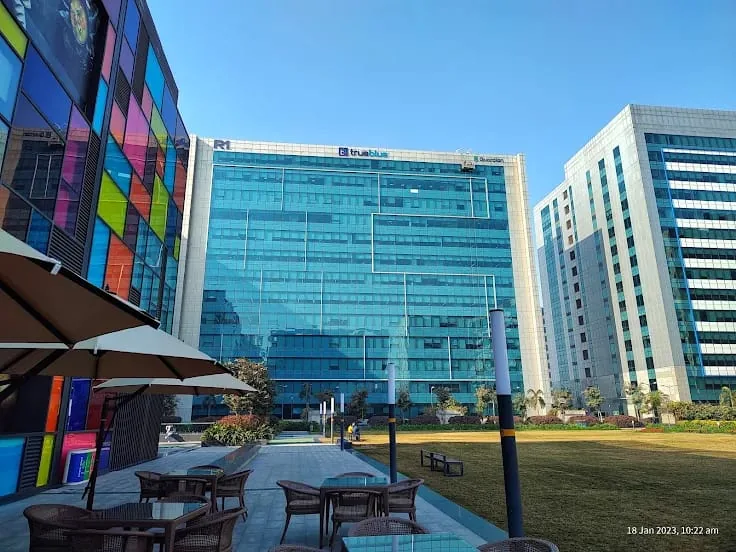
What is Candor TechSpace in Gurugram?
Candor TechSpace is a pair of Brookfield campuses in Gurugram: G1 in Sector 48 and G2 in Sector 21.
Together they hold more than 8 million sq ft of Grade A office space across 25 buildings.
G1 spreads over 25.2 acres with about 3.9 million sq ft of leasable area and 12 completed buildings. G2 spreads over 28.5 acres with about 4.2 million sq ft of leasable area and 13 completed buildings. Both are campus-format office parks with landscaped grounds, retail and food areas, and large floor plates suited to enterprise teams. They are owned and operated by Brookfield India Real Estate Trust.
Where are the two campuses located?
G1 is on Sohna Road in Sector 48, in Gurugram's southern business market. G2 is in Sector 21 close to NH-48.
G1 connects to IGI Airport, metro corridors and the Dwarka Expressway, and G2 has easy access to NH-48.
G1 sits in the Gurugram South micro-market, with access to NH-48, the airport and the Dwarka Expressway. G2 lies in Gurugram's southern business corridor with easy access to NH-48. A company choosing between them can compare commute patterns for its workforce, since the two campuses draw talent from different parts of Gurugram and Delhi NCR.
Are these campuses SEZ, and can floors be denotified for non-SEZ use?
Yes to both. G1 and G2 were developed as IT/ITeS SEZs, and SEZ rules now allow landlords to convert whole floors to non-SEZ use.
The government allowed floor-wise denotification of IT/ITeS SEZs through an amendment to the SEZ Rules, 2006.
The sunset clause on SEZ income-tax incentives began in April 2020, which made SEZ floors less attractive to tenants that no longer needed SEZ benefits. Earlier, only an entire building could be denotified. Under the amendment (Rule 11B), the Board of Approval can permit a landlord to demarcate part of the built-up area as non-processing (non-SEZ) area, floor by floor. A non-processing area must be an entire floor; partial floors are not allowed. Approval carries conditions, including repayment of tax concessions already availed. The landlord applies, the Board of Approval deliberates, and the process runs for several months. Once a floor is demarcated, it can be leased to domestic (non-SEZ) companies like any commercial office, and SEZ and non-SEZ tenants can share one campus.
For a tenant, the choice is practical. SEZ floors suit export-oriented IT/ITeS units that use SEZ benefits and follow SEZ procedures. Non-SEZ floors suit GCCs, consulting, financial services and other companies that want standard commercial lease terms without SEZ compliance. Ask the campus leasing team which floors are SEZ and which are demarcated non-processing before you shortlist space, and plan the fit-out so that drawings, services and layouts follow the approval process for that floor type from the start.
Which certifications and safety ratings do the campuses hold?
Both campuses are IGBC Platinum rated, BEE 5-Star rated and certified to ISO 9001, 14001, 45001 and 50001.
Both hold the British Safety Council Sword of Honour and a five-star occupational health and safety rating.
These ratings cover green building design, energy efficiency, quality, environment, safety and energy management. G1 adds a 469 kWp rooftop solar plant, a 66 kV power sub-station, a sewage treatment plant with ultra-filtration, drip-irrigated landscaping, composting of organic waste and EV charging stations. G2 has rooftop solar panels, drip irrigation, a sewage treatment plant and composting. For global teams with ESG reporting duties, these ratings support the case for leasing here.
What amenities improve employee experience?
Food courts, convenience retail, a wellness centre, a creche, sit-out areas and large green zones are on campus.
About 60% of the G1 site is landscaped green space.
G1 includes event lawns, shaded seating, food courts, retail conveniences and a basketball court. G2 offers sit-out areas with cabanas, a wellness centre, a creche and convenience services. Both campuses are universally accessible, with ramps, tactile indicators, wheelchair facilities and dedicated parking. These basics let employees handle meals, errands and breaks without leaving the campus.
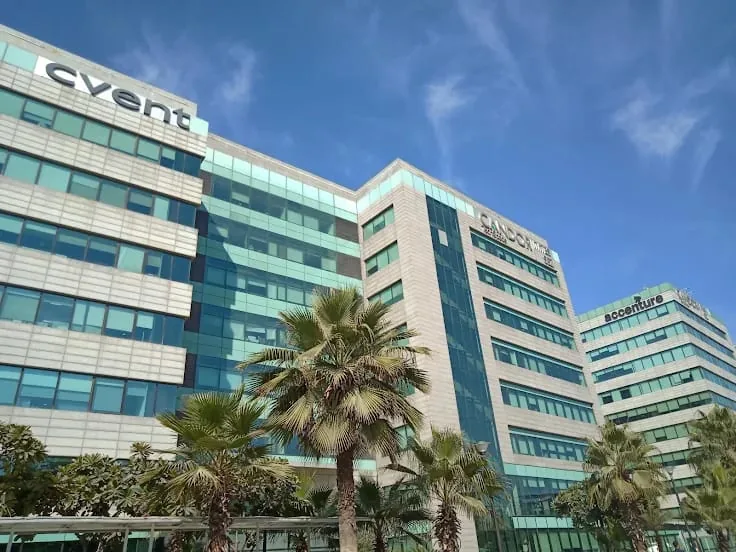
What kind of companies lease here?
IT, consulting, financial services, technology and healthcare companies, including global capability centres, lease at Candor TechSpace.
Large floor plates and campus infrastructure suit teams from a few hundred to several thousand seats.
The campus format lets a company take one or more floors and expand within the same park. This is the same reason many GCCs favour campus parks over single towers: a stable address, shared services and room to grow without relocating.
How should a company fit out an office in Candor TechSpace?
Plan the layout around the building's warm-shell or Grade A base, then design for density, collaboration, branding, IT and handover.
A turnkey design-and-build partner manages approvals, services and execution in one contract.
Fit-out in a managed campus follows the landlord's approval process for drawings, electrical load, HVAC modifications and fire compliance. The main fit-out decisions are seat density, meeting and collaboration zones, acoustics, lighting, pantry and breakout areas, branding, server and IT rooms, and accessibility. Officea Design & Build delivers turnkey office fit-outs across Delhi NCR with offices in Delhi, Gurgaon, Noida and Bangalore, and shares clear terms upfront. Start with the complimentary floor plan audit and test layouts and costs with the office layout planner.
G1 or G2: how do you choose?
Choose G1 for a Sohna Road and southern Gurugram location with large green zones. Choose G2 for a Sector 21 location close to NH-48.
Compare available floors, commute, lease terms and fit-out cost on the same floor plan.
G2 is the larger campus by leasable area, and G1 has the stronger green-space profile. The decision comes down to where your workforce lives, which floors are available, and the total cost of lease plus fit-out. Testing the same seat count in both campuses gives a like-for-like view.
What should a business check before leasing?
Check available area by building, lease terms, handover condition, parking, power, internet, certifications and expansion rights.
Map current and future headcount against the floors you can take now and later.
Checklist: (1) seats needed now and in three years; (2) floor-plate efficiency; (3) lease term, lock-in and escalation; (4) handover condition and fit-out period; (5) parking for staff and visitors; (6) power load and backup; (7) internet and telecom providers; (8) whether the floor is SEZ or demarcated non-SEZ, and which suits your business; (9) commute for your workforce; (10) the right to expand within the campus.
How can a business enquire about space and fit-out?
Share the required area, team size, move-in date, lease term and business type with the campus leasing team and your fit-out partner.
For fit-out, send the floor plan to Officea for a complimentary audit.
Related reading: DLF Cyber City, Gurugram, Candor TechSpace in Noida, turnkey office interiors for GCCs. For Officea's own data on which companies are taking space across NCR, see the Who's Leasing Where report.
Contact Officea Design & Build: [email protected] | +91 98711 11446
Officea Design & Build, a Space Solutions Realty company. BESPOKE DESIGN. TIMELY DELIVERY.