
Which partition is best for an office: glass, gypsum or aluminium?
Gypsum is the best choice for closed rooms because it gives the highest sound reduction per rupee. Glass suits cabins and meeting rooms where daylight must reach the floor, and aluminium-framed systems suit layouts that will be rearranged.
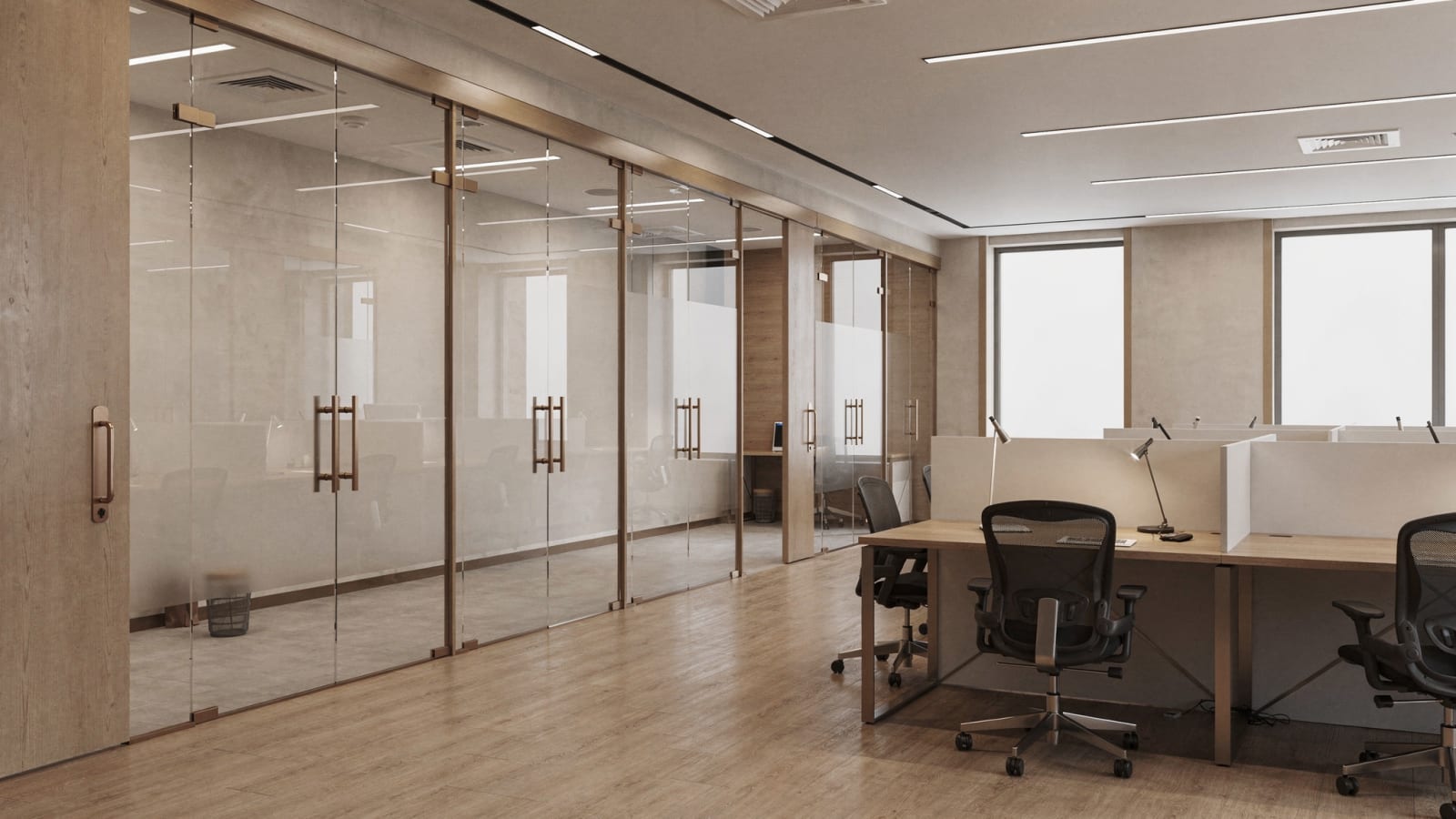
A gypsum partition built on a metal stud frame with board on both faces and mineral wool inside reaches a sound rating of STC 45 to 50, and with fire-rated board it carries a fire rating of 60 to 120 minutes. Single 10 to 12 mm glass reaches STC 32 to 35 and double glass STC 40 or more. Glass partitions are installed fastest and let daylight through, which is why they are used on cabin rows along the window line.
Partitions compared
| Type | Best use | Sound (STC) | Fire rating | Reconfigure |
|---|---|---|---|---|
| Gypsum on metal studs | Closed cabins, boardrooms, server rooms | 45 to 50 | 60 to 120 min with fire board | Low |
| Glass (single) | Cabins, huddle rooms | 32 to 35 | Needs fire-rated glass for rating | Medium |
| Glass (double) | Meeting rooms, training rooms | 40 or more | Needs fire-rated glass for rating | Medium |
| Aluminium-framed modular | Open layouts that change | Depends on infill panel | Non-rated | High |
How does a gap at the partition edge affect sound?
A 0.1% open gap caps the sound rating at STC 30, whatever the partition’s own rating. Sealing the edges and running the wall to the slab decides the real result.
More on room acoustics is in the office acoustics design guide, and fire rules for partitions are in office fire safety requirements in India.
Officea Design & Build’s 2026 rate card for Delhi, Gurgaon and Noida is ₹1,800 to ₹4,500 per sq ft before GST, furniture included. Bangalore is 10% higher, at ₹2,000 to ₹5,000 per sq ft. See the cost index for tier details.
What sound rating do meeting rooms and cabins need?
Use partitions of STC 50 or above for conference rooms and other confidential spaces. Pair them with ceiling absorbers of NRC 0.7 to 0.95 so speech does not build up inside the room.
STC (Sound Transmission Class) rates how well a wall blocks airborne sound, tested to ASTM E90. NRC (Noise Reduction Coefficient) is a number from 0 to 1 for how much sound a surface absorbs, tested to ASTM C423. Blocking and absorbing are different jobs. Glass, concrete and metal reflect sound, so a room with glass walls needs more absorption in the ceiling, not less.
Should a partition stop at the false ceiling?
No. Take cabin and meeting room partitions up to the slab and seal the junctions. A wall that stops at the false ceiling lets sound travel over it through the shared ceiling void.
Most acoustic failures in Indian offices come from gaps, unsealed ceiling junctions and shared ceiling voids, not from the rating printed on a material. For lawyers’ cabins and other private rooms we take partitions to the slab, use acoustic-rated glass or drywall, seal the doors and treat the ceiling void. See the office acoustics design guide.
Do new partitions change fire safety?
Yes. New partitions change sprinkler coverage, detection and escape routes, so the layout must be redesigned, approved by the landlord and, where state rules require it, cleared by the fire department before occupation.
A full-height wall can put a new cabin outside the spray of the nearest sprinkler head. A desk 25 m from a stair on an empty floor can be over 30 m away once you walk around cabins, so travel distance is checked on the fitted-out layout, and a partition must never block an exit or its route. Read office fire safety requirements in India.