
Quick answer
An office electricity bill usually rises because air conditioning runs longer or works harder than it needs to, lights and equipment stay on after hours, the office has added people and machines, the diesel generator (DG) is running more, or the tariff itself has changed. Air conditioning is normally the largest single load in an Indian office, so start there. Read the meter at fixed times for a week, compare working hours with nights and Sundays, and check AC schedules and setpoints before you spend money on upgrades.
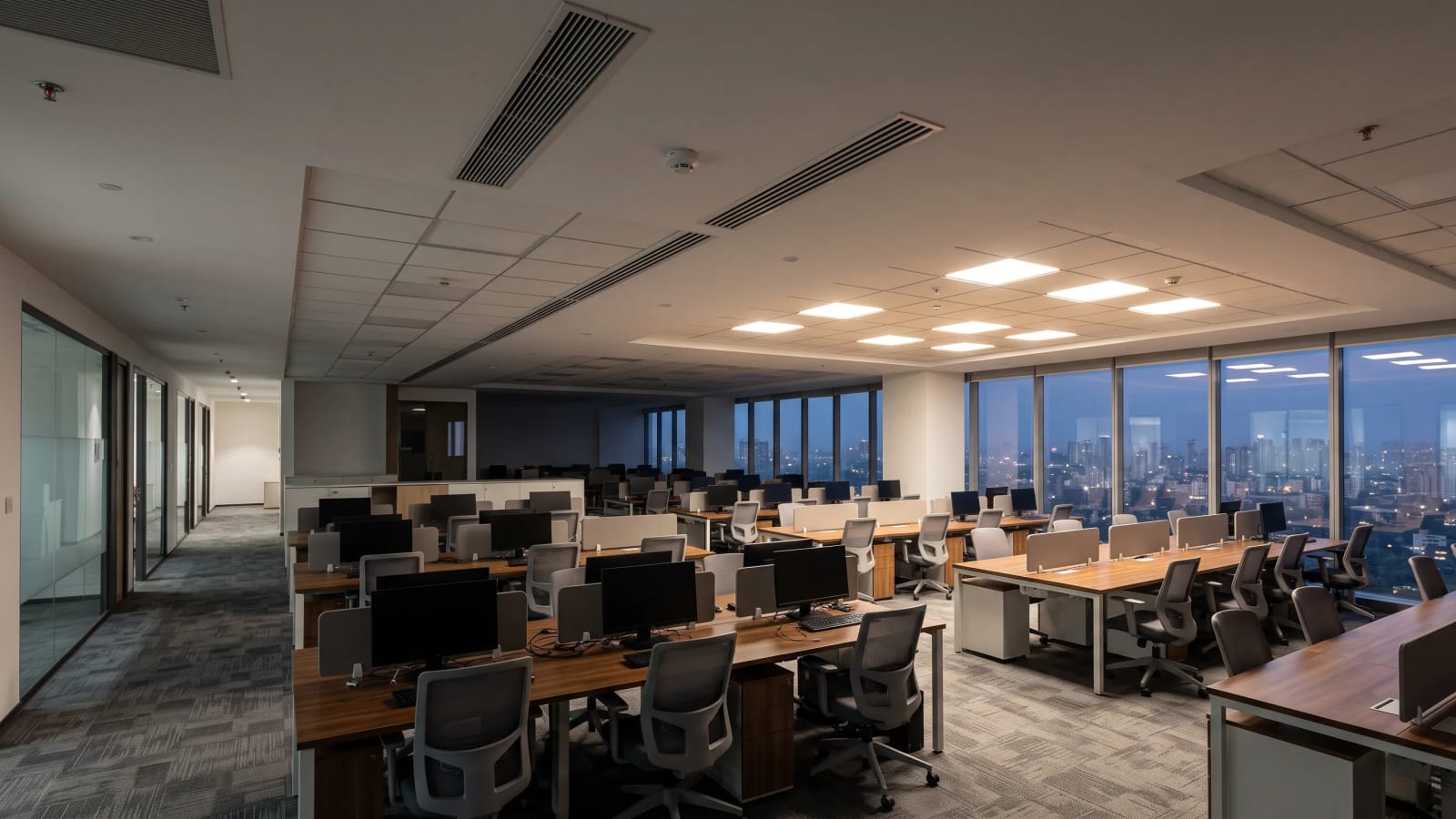
The office is the same size, the team is roughly the same, yet the electricity bill has crept up month after month. Finance asks why, and nobody in admin has a clear answer. This guide is for admin and facilities heads, CFOs and founders: the usual reasons an office electricity bill increases, the checks your team can do with nothing more than the meter and the bill, and the upgrades worth considering once you know where the units are going.
Why is our office electricity bill increasing?
A higher bill has only two possible sources: you are using more units (kWh or kVAh), or each unit costs more. Most offices have a mix of both. The table sorts the usual causes, what points to each one and who normally fixes it.
| Cause | What points to it | Who usually fixes it |
|---|---|---|
| AC running outside office hours | High readings at night, early morning or on Sundays; AC on before anyone arrives | Facility team, building management system (BMS) or AMC vendor (schedules and timers) |
| AC setpoints too low | People wear jackets indoors; some cabins feel cold while others are warm | Facility team (setpoint policy), HVAC contractor (balancing) |
| Old or poorly maintained AC | Units run for long periods without reaching temperature; dirty filters, iced or dusty coils, overdue service | AMC vendor or HVAC contractor |
| Lights left on | Lights on in empty meeting rooms, cabins, store rooms and after hours; no sensors or timers | Facility team first, then electrical contractor (sensors and controls) |
| More people and equipment | New desks, extra monitors, a bigger server or IT room, more pantry appliances since the last fit-out | Admin and IT (equipment policy), engineer (load review) |
| More DG usage | More power cuts, DG running hours rising, separate DG charges from the landlord | Building or landlord, facility team (what runs on DG) |
| Tariff or billing changes | Units are flat but the amount is higher; new charges or a changed rate on the bill | Finance and admin (bill review with the utility or landlord) |
| Low power factor | Power factor penalty, or kVAh units well above kWh units, on the bill | Electrical contractor (capacitor bank or power factor correction panel) |
Two or three of these usually act together. An office that gained thirty desks, a second server rack and an AC that now starts at 7 am will see a bigger jump than any single cause suggests.
How much of the bill is air conditioning?
In most Indian offices, air conditioning is the largest single user of electricity, followed by lighting, IT equipment, the server or hub room and the pantry. The exact split depends on the building, the type of AC, the hours you run and how much glass faces the sun, so measure your own office rather than relying on a general figure.
The AC habits that push the bill up are easy to spot once you look for them:
- Long running hours. AC switched on well before people arrive, left on in empty areas, or running through the night and on holidays because nobody set a schedule.
- Setpoints that are too low. Every degree colder means the compressor works longer. Many offices run at 20 to 21°C when people would be comfortable a little warmer. The Bureau of Energy Efficiency (BEE) has promoted a default of 24°C for air conditioners; agree a setpoint that suits your team and stick to it.
- Poor maintenance. Clogged filters, dirty coils and low refrigerant make units run longer for the same cooling.
- Units fighting each other. When one zone is too cold and the next too warm, people turn thermostats down and open doors. Our guide on why one cabin is colder than another explains the balancing fixes.
- Old equipment. Older split units and chillers are usually less efficient than current BEE star-rated models, and their performance drops further as they age.
In buildings on a central chilled water plant, cooling is often billed separately from electricity, by the landlord, based on a BTU meter, tonnage or your share of the floor. If that charge is rising, the same habits apply: running hours and setpoints drive it. Our office HVAC design guide and VRF vs chilled water comparison explain how each system is metered and controlled.
Is it usage or the tariff? How to read the bill
Before blaming the office, check the bill itself. Put the last twelve months side by side and separate three numbers: units consumed, the rate per unit and the fixed or demand charges. If units are flat but the amount has gone up, the cost is in the tariff, not in your office.
- Tariff revisions. State electricity regulatory commissions revise tariffs from time to time, and fuel or power purchase adjustment charges can change monthly. Check whether the rate per unit or the adjustment line has moved.
- Fixed and demand charges. These depend on your sanctioned or contract load and maximum demand. If the office has grown, a higher recorded demand can raise the fixed part of the bill.
- Time-of-day tariffs. Some states charge more for units used in peak hours. Shifting loads you control, such as pre-cooling or water heating, can matter.
- kWh or kVAh billing. Where commercial connections are billed in kVAh, or carry a power factor penalty, a poor power factor means you pay for power you do not use. Your electrician can check it.
- Landlord sub-metering. In multi-tenant buildings, the landlord may bill you from a sub-meter at a rate that includes common area, DG or maintenance elements. Ask for the meter readings, the rate and how DG units are charged.
- DG units. Power from the diesel generator usually costs much more per unit than grid power. More outages, or the whole floor on DG backup when only critical loads need it, push the bill up.
What checks can the admin team do?
Your own team can find most of the waste without tools, ladders or access to electrical panels. Keep to readings, schedules and walk-rounds.
- Read the meter by the hour for a week. Note the reading at opening, lunchtime, closing, late evening and first thing next morning, plus Saturday and Sunday. Units used at night and on Sundays are your base load. If it is high, something is running that should not be.
- Check AC schedules and the BMS. Ask the building or AMC vendor for the on and off times of every AC unit, AHU and fresh air unit, including Saturdays and holidays. Compare them with the hours people actually use the office.
- Check setpoints. Walk round with a simple thermometer and note the setpoint on each thermostat or remote. Agree one office-wide setpoint and note any rooms that cannot hold it.
- Do an after-hours walk-round. At 9 pm on a working day, list every light, AC, monitor, printer, water dispenser and pantry appliance still on.
- List what has been added. Count desks, monitors, server or IT room equipment and pantry appliances against the last fit-out. More people and machines mean more units, which is normal growth, not waste.
- Check DG running hours. Ask how many hours the DG ran each month and which circuits it feeds.
- Review the AC service log. When were filters cleaned and units serviced last? Are any units running continuously or tripping?
- Put twelve months of bills in one sheet. Units, rate, fixed charges, DG units and power factor lines, month by month. The pattern usually shows whether the jump came from usage, tariff or both.
Do not open electrical panels, change breakers or alter AC settings inside the equipment yourselves. If the building controls the AC plant, raise schedule and setpoint changes with the landlord’s facility team.
Which upgrades reduce office electricity use?
Fix schedules, setpoints and maintenance first: they cost little and often make the biggest difference. Once the habits are right, these upgrades are worth pricing. Savings depend on your hours, equipment and tariff, so ask for an estimate based on your own meter readings rather than a general percentage.
| Upgrade | When it suits | Disruption |
|---|---|---|
| Timers and BMS schedules for AC and lights | Equipment runs outside office hours | Low |
| LED lighting in place of old tube lights or CFL fittings | Older fittings still in use | Low to medium: fixture swaps, sometimes ceiling tiles |
| Occupancy and daylight sensors | Meeting rooms, cabins, toilets, stores and desks near windows | Low to medium |
| Power factor correction | Power factor penalty or kVAh billing with a poor power factor | Low to medium: panel work by an electrician |
| Zoning the AC (separate control for meeting rooms, cabins and late-working teams) | The whole floor runs to cool a few people | Medium |
| Replacing old AC units with efficient, star-rated or VRF systems | Units are old, unreliable or undersized | Higher: best planned with a refresh or fit-out |
| Solar film or blinds on sun-facing glass | Strong afternoon sun on west or south glazing | Low to medium |
VRF systems let each zone run only when needed, which is why they suit offices where some teams work late. Our office lighting design guide covers LED fixtures and controls, and the office electrical design guide explains load schedules, DG backup and metering. Larger changes are best done together with other planned work, such as an office refresh, so the ceiling is opened once.
When should you call an electrical or HVAC professional?
Call a qualified electrician or HVAC engineer when the base load at night stays high after your checks, when the bill shows a power factor penalty, when AC units run all day without reaching temperature, when breakers trip as load grows, or when you are planning more desks than the original design allowed. If tripping is already a problem, read why office breakers keep tripping.
Ask them for an energy walk-through: measured loads on the main circuits, AC performance against capacity, power factor, DG connected load and a written list of fixes with estimated cost and payback based on your own readings. In a multi-tenant building, involve the landlord’s facility team, because they control the plant, the sub-meters and the DG.
This is general guidance. Electrical and HVAC changes depend on your building, connection and local rules: confirm any change with a qualified electrical engineer or HVAC professional, your building’s facility team and the landlord before work starts.
For other everyday office issues, browse office problems and solutions. If you are planning upgrades alongside a wider update, see our office refresh service. Officea designs and builds offices, including lighting, electrical and air conditioning, under one contract from studios in Delhi (Nehru Place), Gurgaon (DLF Grand Mall), Noida (Sector 3) and Bangalore (Residency Road). If your electricity bill keeps rising, ask us for a complimentary review of your lighting, AC zoning and layout.
Frequently asked questions
Why is our office electricity bill so high when headcount has not changed?
Usually because air conditioning runs longer or colder than needed, lights and equipment stay on after hours, the DG runs more, or the tariff has changed. Read the meter at fixed times for a week and compare units with the last twelve bills to see which it is.
What uses the most electricity in an office?
In most Indian offices air conditioning is the largest single load, followed by lighting, IT equipment, the server or hub room and the pantry. The split varies by building and hours, so measure your own office.
What temperature should office AC be set at to save electricity?
Every degree colder makes the AC work longer. The Bureau of Energy Efficiency has promoted 24°C as a default setting for air conditioners; agree one office-wide setpoint that keeps your team comfortable and avoid running it at 20 to 21°C.
How do I know if the bill went up because of the tariff?
Compare units consumed with the amount billed month by month. If units are flat but the amount rose, check the rate per unit, fuel or power purchase adjustment, fixed or demand charges and any power factor penalty.
Will LED lights and occupancy sensors reduce our bill?
They reduce lighting load, especially where old fittings remain and rooms are often empty with lights on. How much you save depends on your hours and tariff, so ask for an estimate based on your own meter readings.